Component Assembler
The Component Assembler is a powered workbench that combines items with a fluid. It makes  Primed Cell Cores and the material Battery Cells built from them, Corrosion Cell Anodes, late-game Servos and frame parts that need Lubricant, the
 Biogas Membrane, and
 Void Catalyst.
It started life as the Battery Assembler, which is why its resource id is still battery_assembler. Each Component Assembler you craft rolls its own rarity and affixes.
You can read an Assembler from the outside. Each input slot is a pocket along the front of the bed, and its item lies in it, in slot order from left to right. While the Assembler works, the head on the gantry picks up the item from each filled pocket in turn and carries it to the nest behind them. A pocket stays filled if its slot holds more than the job takes. When the recipe takes fluid, the head ends the job by pouring it over the items on the nest. The puddle soaks in and leaves the finished part. The output rack is the row of four cubbies in the back cabinet, and finished items stand in them. The assembly fluid shows in the glass reservoir on the roof, and the Battery Cell lies beside it, with a charge meter on the left side of the cabinet. FE and fluid still enter on any side, but the cable port is drawn on the back.
Obtaining
Crafting
| Ingredients | Crafting recipe | Notes |
|---|---|---|
| Cell Shell + Conductive Plate + Redstone Dust + Machine Frame |     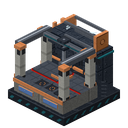 | Requires the Iron material to be enabled. Requires the Copper material to be enabled. |
Breaking
Mine a placed Component Assembler with a pickaxe. It drops itself and keeps its rolled traits.
Usage
Assembling
Put the item ingredients in the four input slots on the Process tab and fill the assembly tank with the fluid the recipe needs. The machine then runs on FE and places the result in its four-slot output rack. Ingredients go in slot order: the recipe's first ingredient in the first slot, the second in the next, and so on. Leave unused input slots empty. Some recipes take more than one of an item from a single input slot, such as four Redstone for a Servo.
The tank holds 4,000 mB of one assembly fluid at a time:
- Electrolyte Solution for Primed Cell Cores, Anodes, and the Primed Seal Core.
- Lubricant for Servos, the Lubricated Seal Core, and the
 Lubricated Frame Coupling.
- Ender Slurry for Void Catalyst.
You can fill the tank three ways:
- Pipe the fluid in from any side.
- Put a filled bucket or other fluid container in the fluid slot.
- Put dry
 Electrolyte in the fluid slot. Each one dissolves into 125 mB of Electrolyte Solution, so you can make batteries before you reach the Melter. Dry electrolyte cannot make Lubricant.
To switch fluids, press the purge button on the Process tab or right-click the machine with a  Purge Bucket. Each purge voids up to 1,000 mB and resets the current job.
Battery Cells
Battery Cells are made in two steps:
- Assemble a Primed Cell Core from a Cell Shell, a Conductive Plate, and 250 mB of Electrolyte Solution. Primed Cell Cores stack, hold no FE, and have no traits.
- Assemble a final cell from one Primed Cell Core, the material's plate or ingot, and Redstone. Sparksteel and higher cells also need a
 Stabilization Catalyst.
The finished cell starts empty and rolls its own traits when assembly completes. See Battery Cells for each material's capacity and stage. Potato, Iron, Copper, and Lead cells also have crafting-table recipes that use dry electrolyte, so you can make your first cells without the Assembler.
Other components
- Anodes: two Aluminum, Titanium, Tungstensteel, or Naquadah plates and 250 mB of Electrolyte Solution make one Anode, the fuel for a Corrosion Cell.
- Servos: Titanium and higher Servos are assembled with Lubricant.
- Lubricated Frame Coupling: a Tungstensteel Casing and 1,000 mB of Lubricant, used to craft the Exotic Machine Frame.
- Void Catalyst: a Nullite Ingot, a Tungstensteel Plate, and 1,000 mB of Ender Slurry make the Vacuum Collapse Generator's fuel.
- Biogas Membrane: a Calibrated Storage Component, two Rubber, and a Titanium Plate, with no fluid. The membrane remembers the component's calibration stability, which sets its Methane recovery in a Bio Generator.
- Seal Cores: the Primed and Lubricated Seal Cores used to craft Ascendancy Seals. See Machine Mastery.
Gear
The Gear tab has one optional Battery Cell slot. FE you supply fills the machine's internal buffer first, then charges the cell. While running, it spends the buffer first and then draws from the cell. Without a cell, it runs on its internal buffer alone.
Automation
| Side | Behavior |
|---|---|
| Top | Inserts into the four item input slots. Each slot accepts only what a recipe matching the other filled slots needs in that position. An item a recipe needs in two positions fills both evenly; see Automation. |
| Bottom | Extracts finished items from the output rack. Ingredient leftovers are pushed into the inventory below; see Automation. |
| Sides | Insert dry electrolyte or filled fluid containers into the fluid slot, and extract empty containers. |
| Any | Accepts FE and assembly fluids, for example from a Universal Cable. |
Gear slots are not reachable by automation.
Component assembly recipes
The Component Assembler uses the rngtech:battery_assembly recipe type.
| Input | Output | Time | Energy | Rolls traits | Record calibration | |
|---|---|---|---|---|---|---|
 | → |  | 16 s | 6,800 FE | Yes | |
  250 | → |  | 10 s | 4,800 FE | No | |
 | → |  | 13 s | 4,400 FE | Yes | |
  2  | → | | 12 s | 6,000 FE | No | Yes |
  | → |  | 6.5 s | 1,400 FE | Yes | |
 | → |  | 18 s | 8,000 FE | Yes | |
 4  2    1k | → |  | 18 s | 9,600 FE | No | |
  | → |  | 8.5 s | 2,200 FE | Yes | |
  | → |  | 6 s | 1,200 FE | Yes | |
  | → |  | 7.5 s | 1,800 FE | Yes | |
 1k | → | | 8 s | 2,400 FE | No | |
   1k | → |  | 30 s | 32,000 FE | No | |
| 250 | → |  | 10 s | 4,800 FE | No | |
 | → |  | 15 s | 6,000 FE | Yes | |
4 2  1k | → |  | 15 s | 7,200 FE | No | |
| 250 | → | | 4 s | 800 FE | No | |
  41k | → | | 20 s | 12,000 FE | No | |
 | → |  | 11 s | 3,200 FE | Yes | |
| 250 | → |  | 10 s | 4,800 FE | No | |
4 21k | → | | 12 s | 4,800 FE | No | |
 250 | → |  | 10 s | 4,800 FE | No | |
4 21k | → |  | 15 s | 7,200 FE | No | |
 1k | → | | 15 s | 7,200 FE | No |
Screen
The Component Assembler screen has four tabs:
- Process: four item inputs, the fluid slot and tank with its purge button, the output rack, progress, and energy. Hover the progress bar for time remaining and expected items per minute.
- Gear: the Battery Cell slot.
- Stats: the machine's current stats, including traits and Gear.
- Refinement: refine the placed Assembler's traits with a catalyst.
Data values
| Name | Resource location | Form | Translation key |
|---|---|---|---|
| Component Assembler | rngtech:battery_assembler | Block | block.rngtech.battery_assembler |
| Primed Cell Core | rngtech:battery_cell | Item | item.rngtech.battery_cell |
| Lubricated Frame Coupling | rngtech:lubricated_frame_coupling | Item | item.rngtech.lubricated_frame_coupling |
See also
- Battery Cells
- Melter, for bulk Electrolyte Solution, Lubricant, and Ender Slurry.
- Corrosion Cell
- Battery Chassis
RNGTech wiki
| Guides |  Automation · Battery Cells ·  Dormant Machines ·  Gear ·  Getting Started ·  Heat ·  Machine Mastery · Machine Stats ·  Modpack Creators ·  Power Chains ·  Rarity and Affixes ·  Stages ·  Uniques |
|---|---|
| Processing |  Alloy Furnace · Component Assembler ·  Component Recycler ·  Crusher ·  Furnace ·  Melter ·  Metal Press ·  Resonance Calibrator ·  Wooden Composter |
| Power generation |  Bio Generator ·  Cavitation Generator ·  Corrosion Cell ·  Fuel Cell ·  Potential Reactor ·  Solar Panel ·  Solid Fuel Burner · Syngas Combustor ·  Vacuum Collapse Generator |
| Energy storage |  Battery Chassis |
| Fluids and gases |  Algae Photobioreactor ·  Ammonia Synthesizer ·  Coal Gasifier ·  Fluid and Compressor Tanks ·  Silica Gel Dehumidifier ·  Steam Methane Reformer ·  Wooden Dehumidifier |
| Refinement |  Affix Forge ·  Exotic Affix Forge |
| Logistics |  Universal Cable |
| Tools |  Forestry Cart Station ·  Miner's Companion ·  Modular Tools ·  Tool Bench |