Corrosion Cell
The Corrosion Cell is a Stage 4 generator that makes FE by eating metal, the way an aluminium-air battery does. Each cycle it dissolves one plate, Anode, or piece of Scrap in electrolyte, produces a batch of FE, and leaves behind  Corrosion Residue. Early on it burns plain Iron and Copper Plates. From Stage 5 you feed it Anodes, which need a matching Cathode installed. You choose how hard to run it: full rated load for the most FE/t, or a lighter load for more FE out of every fuel. See Power Chains for the machines that make its fuel.
You can watch it work. The fuel hangs from the copper bus bar in a glass electrolyte bath and dissolves from the bottom up. Hydrogen bubbles stream off it, more of them at a higher load, and a faint mist rises from the vent stack at the back. The electrolyte turns cloudy as it fills with dissolved metal and clears with each fresh dose. The installed Cathode lines the back of the bath in its metal's colour, and the blower on top that feeds it air spins with the current. The ammeter on the front shows the current, and the lamp in the other front corner lights while the cell works. Residue settles in the sludge trap at the bottom of the bath as the residue slot fills, and the sight glass on the side shows the electrolyte tank.
Like every RNGTech machine, each Corrosion Cell you craft rolls its own rarity and affixes.
Obtaining
Crafting
| Ingredients | Crafting recipe |
|---|---|
| Steel Casing + Electrolyte + Redstone Dust + Reinforced Machine Frame + Bus Bar |      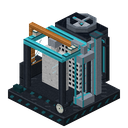 |
Breaking
Mine a placed Corrosion Cell with a pickaxe. It drops itself. Installed Gear and stored items drop separately.
Usage
Generating power
Each cycle needs two things:
- Fuel: one plate, Anode, or
 Scrap in the plate slot.
- Electrolyte: one Electrolyte in the electrolyte slot, or 125 mB of Electrolyte Solution from the internal tank. The dry item is used first when both are present.
The cell then generates the fuel's FE over the cycle and drops one Corrosion Residue into the output slot. It pulls the next fuel only when the residue slot has room and its internal buffer or installed Battery Cell can still take FE. If the buffer fills mid-cycle, the fuel stops dissolving until FE is drawn away, so no FE is lost. Clear the residue and draw FE away, or the cell sits idle. The cell does not limit its own output, so the receiver or connector tier decides how much FE moves each tick. A redstone signal pauses it, and it resumes the same fuel when the signal ends.
The electrolyte tank holds 4,000 mB, and a Fluid Pump's Fluid Capacity rolls make it bigger. To empty it, use the purge button on the Process tab or right-click the cell with a  Purge Bucket. Each purge voids up to 1,000 mB.
Load
The load is the share of its rated current the cell draws. Each fuel holds a fixed amount of charge, so the load sets how fast the fuel dissolves. A lighter load also runs the cell at a higher voltage, so each fuel is worth more FE. Rated load (100%) makes the most FE/t and gives exactly the recipe's FE and cycle time. New cells start there.
Lower loads trade FE/t for FE per fuel. Two cells at 50% together make 1.125 times the FE/t of one cell at rated load, and they get 12.5% more FE out of every fuel. That pays off when fuel, such as Anodes, runs short before cells do. Each fuel still uses one Electrolyte and leaves one Corrosion Residue, so a lighter load also gets more FE from each Electrolyte.
| Load | FE/t | FE per fuel | Cycle length |
|---|---|---|---|
| 40% | x0.46 | x1.15 | x2.50 |
| 50% | x0.56 | x1.125 | x2.00 |
| 60% | x0.66 | x1.10 | x1.67 |
| 70% | x0.75 | x1.075 | x1.43 |
| 80% | x0.84 | x1.05 | x1.25 |
| 90% | x0.92 | x1.025 | x1.11 |
| 100% (rated) | x1.00 | x1.00 | x1.00 |
Set the load on the gauge below the cycle bar in the Process tab. Click a point on it, or scroll over it to move 5%. The load runs from 40% to 100%; the table shows every 10%. The gauge draws the trade: the teal profile is the FE/t at each load, lit up to the current the cell draws right now, and the amber line is the FE per fuel. The white pointer marks your setting. Hover the gauge for the exact numbers and the cell voltage. A load change applies to the rest of the fuel already in the bath.
Fuel tiers
Plain plates burn on their own. From Stage 5, the main fuel is an Anode: two plates of one metal assembled with 250 mB of Electrolyte Solution and 4,800 FE in the Component Assembler. An Anode burns for twice as long as a plate and produces far more FE, but it only burns when the installed Cathode is at least the Anode's stage. A higher-tier plate still burns without a Cathode, at roughly 40% of its Anode's FE/t.
| Fuel | Stage | FE/t (base, rated load) | Cathode needed |
|---|---|---|---|
| Scrap |
4 | 30 | None |
 Iron Plate |
4 | 80 | None |
 Copper Plate |
4 | 100 | None |
 Aluminum Anode |
5 | 200 |  Aluminum Cathode or better |
 Titanium Anode |
6 | 480 |  Titanium Cathode or better |
 Tungstensteel Anode |
7 | 900 |  Tungstensteel Cathode or better |
 Naquadah Anode |
8 | 1,800 |  Naquadah Cathode |
Values are before machine and Cathode rolls. Every Anode tier stays below that stage's main generator once you count its assembly cost.
Gear
The Gear tab has three optional slots:
- Battery Cell: adds FE storage. It accepts cells up to Stage 5.
- Fluid Pump: lets pipes fill the electrolyte tank from any face. Without one, the cell runs on dry Electrolyte items. The pump's Fluid Transfer sets the fill rate.
- Cathode: sets the highest Anode stage the cell can burn. Its rolled Energy Generation, Efficiency, Processing Speed, and Stability affixes apply to the cell, and each stage above Aluminum adds 2% base Efficiency.
None of the Gear is required to burn plates, Scrap, and dry Electrolyte.
Automation
| Side | Behavior |
|---|---|
| Top | Inserts plates, Anodes, and Scrap. |
| Bottom | Extracts Corrosion Residue. |
| Sides | Insert plates, Anodes, Scrap, or Electrolyte. |
| Every face | Outputs FE, for example into a Universal Cable. Fills Electrolyte Solution when a Fluid Pump is installed. |
A connector works on any face. The port on the back, a dark plate with a teal ring, marks the tidy spot for one, clear of the tank window and the blower.
Gear slots are not reachable by automation.
Corrosion Cell recipes
The Corrosion Cell uses its own recipe type, rngtech:corrosion_cell. Every recipe takes one Electrolyte (or 125 mB of Electrolyte Solution) and returns one Corrosion Residue.
| Input | Output | Time | Energy | Min. cathode stage | |
|---|---|---|---|---|---|
| → | | 16 s | 64,000 FE | 5 |
 | → | | 8 s | 12,800 FE | |
| → | | 8 s | 16,000 FE | |
| → | | 8 s | 12,800 FE | |
| → | | 16 s | 576,000 FE | 8 |
 | → | | 8 s | 115,200 FE | |
| → | | 8 s | 4,800 FE | |
| → | | 16 s | 153,600 FE | 6 |
 | → | | 8 s | 30,720 FE | |
| → | | 16 s | 288,000 FE | 7 |
 | → | | 8 s | 57,600 FE |
Screen
The Corrosion Cell screen has four tabs:
- Process: the plate and electrolyte slots, the electrolyte tank with its purge button, the residue slot, FE, cycle progress, and the load gauge. Click the recipe line to open its JEI category.
- Gear: Battery Cell, Fluid Pump, and Cathode slots.
- Stats: the machine's current stats, including traits and Gear.
- Refinement: refine the placed cell's traits with a catalyst.
Data values
| Name | Resource location | Form | Translation key |
|---|---|---|---|
| Corrosion Cell | rngtech:corrosion_cell | Block | block.rngtech.corrosion_cell |
See also
- Component Assembler, which builds Anodes.
- Machine Stats
RNGTech wiki
| Guides |  Automation ·  Battery Cells ·  Dormant Machines ·  Gear ·  Getting Started ·  Heat ·  Machine Mastery · Machine Stats ·  Modpack Creators ·  Power Chains ·  Rarity and Affixes ·  Stages ·  Uniques |
|---|---|
| Processing |  Alloy Furnace ·  Component Assembler ·  Component Recycler ·  Crusher ·  Furnace ·  Melter ·  Metal Press ·  Resonance Calibrator ·  Wooden Composter |
| Power generation |  Bio Generator ·  Cavitation Generator · Corrosion Cell ·  Fuel Cell ·  Potential Reactor ·  Solar Panel ·  Solid Fuel Burner · Syngas Combustor ·  Vacuum Collapse Generator |
| Energy storage |  Battery Chassis |
| Fluids and gases |  Algae Photobioreactor ·  Ammonia Synthesizer ·  Coal Gasifier ·  Fluid and Compressor Tanks ·  Silica Gel Dehumidifier ·  Steam Methane Reformer ·  Wooden Dehumidifier |
| Refinement |  Affix Forge ·  Exotic Affix Forge |
| Logistics |  Universal Cable |
| Tools |  Forestry Cart Station ·  Miner's Companion ·  Modular Tools ·  Tool Bench |