Metal Press
The Metal Press forms ingots into plates, gears, and casings, presses circuit blanks into Electric Circuits, and presses coils, casings, and gears into Universal Cable connectors. The installed Mold decides what it makes. There are two presses: the Crude Metal Press is the early bootstrap press, and the Stage 4 Metal Press (the Steel press) is faster and more controlled but can fail.
Both presses run on FE and heat up before pressing. Like every RNGTech machine, each press you craft rolls its own rarity and affixes, and it can level up through Machine Mastery.
You can read a press from the outside. The selected Mold sits on the bed as the die with the input lying on it, and the other stored Molds stand in the rack on the back cabinet. While the press works, the ram comes down as the cycle runs and strikes when it finishes, and pressed parts collect in the tray at the front of the bed. The bed and the die glow from dull red to yellow-white with the heat. The bar on the front of the bed reads like the heat bar on the Process tab: it fills with the heat against the Heat Core's Max Temperature, a white mark shows the recipe's target and a yellow mark the setpoint, and the fill turns red while the press overheats. Facing the front, the Heat Core is the finned radiator on the right and the Battery Cell stands in the cradle on the left with its charge meter. The gas cylinder behind the cradle is the atmosphere tank: its window shows how full it is, pale blue for Nitrogen and near white for Hydrogen, and its valve lights up while the press uses Nitrogen. The cable port is on the back.
The Steel press is a servo press: the Servo lies on the crown and drives the ram, and the meter next to the heat bar fills from amber to red with failure strain and blinks when a failure is near. The Crude press is a bronze fly press: copper coils heat its firebrick bed, and the screw and its fly bar turn as the ram comes down. A Servo installed in a Crude press sits behind the crosshead.
Obtaining
Crafting
Each press has its own recipe. The Steel press is built on a regular Machine Frame and does not use up a Crude Metal Press.
| Ingredients | Crafting recipe | Notes |
|---|---|---|
| Crude Metal Press Bronze Plate + Iron Ingot + Redstone Dust + Furnace Machine Chassis + Copper Coil |       | Requires the Bronze material to be enabled. Requires the Copper material to be enabled. |
| Metal Press Steel Plate + Basic Electric Circuit + Redstone Dust + Machine Frame + Steel Servo |     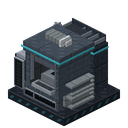 | Requires the Bronze material to be enabled. Requires the Steel material to be enabled. |
Breaking
Mine a placed press with a pickaxe. It drops itself and keeps its rolled traits and Mastery progress. Items inside it, including installed Gear and stored Molds, drop next to it.
Usage
Pressing
Install a Heat Core and at least one Mold, select the Mold you want in the Gear tab, then put the input in the input slot and supply FE. The press heats up and starts pressing once its heat reaches the recipe's temperature; without FE its heater stops and it cools. See Heat for how it heats, what the FE pays for, and the overheat slider. Adding more of the same input keeps the current press going, so a hopper or Item Connector can feed it; swapping the input for a different item restarts it.
Each recipe has a heat window and a temperature stability requirement. The two presses handle a bad window differently:
- The Crude Metal Press never fails. If its heat is too low or too high, its stability is too low, or it runs out of power, it pauses and leaves the input alone. A press that is too hot cools down before continuing.
- The Metal Press builds up failure strain instead. Low heat, low stability, a weak Servo, or a power drop after pressing starts all add strain. Like the Crude press, it cools down to the recipe's overheat temperature before pressing when a hotter recipe left it above that. When strain fills, the input is used up and the press outputs a failure item: a
 Malformed Ingot for plates and casings, or a
 Broken Circuit for circuits. Smelt Malformed Ingots in a Furnace to get two nuggets back, or keep Stage 5 and higher ones for the Volatile Catalyst. The Potential Reactor and Component Recycler can recover scrap from Broken Circuits.
Molds
| Mold | Makes | Input |
|---|---|---|
 Plate Mold |
Material plates | 1 ingot |
 Gear Mold |
Material gears | 3 ingots |
 Casing Mold |
Material casings, for the metals that use them | 4 ingots |
 Circuit Mold |
Electric Circuits | 1 circuit blank |
 Connector Mold |
Energy, Fluid, and Item Connectors for the Universal Cable | 1 coil, casing, or gear; 8 Nullite Coils for the Exotic Energy Connector |
The press stores up to five Molds, so you can keep all of them installed and switch between them in the Gear tab. Selecting another Mold, or swapping the Heat Core, Servo, or a Mold, restarts the current press.
Circuits
Electric Circuits are a main reason to build a press. Every tier works the same way: craft four circuit blanks at a crafting table, then press each blank into a circuit with the Circuit Mold. Each tier's blank needs the circuit from the tier below, so you climb the chain in order:
- Insulators. Craft
 Insulator from glass, quartz, clay, and smooth stone. Every blank uses them.
- Basic. A
 Basic Circuit Blank needs Insulators, a Bronze Plate, a Copper Coil, redstone, and quartz. A Bronze Heat Core is enough to press it into a Basic Electric Circuit.
- Calibrate. Run a Basic Electric Circuit through a Resonance Calibrator to get a
 Calibrated Logic Component. Its stability roll decides which higher blanks it can go into.
- Advanced. An
 Advanced Circuit Blank needs a Basic circuit, Gold Coils, a Steel Plate, Insulators, and a Calibrated Logic Component with 55 or more stability. A well-equipped Crude Metal Press can press it.
- Elite. An
 Elite Circuit Blank needs an Advanced circuit, Titanium Plates, a Titanium Control Board, a Titanium Resonance Coil, an Arclite Coil, Insulators, and a Calibrated Logic Component with 80 or more stability.
- Ultimate. An
 Ultimate Circuit Blank needs an Elite circuit, Tungstensteel Plates, Naquadah Coils, a Nullite Resonance Coil, Insulators, and a Stage 6
 Calibrated Diamond Crystal with 85 or more stability.
Elite and Ultimate circuits expect the Steel press or a strongly upgraded Crude press. The Notes column below shows the stage and stability each calibrated ingredient needs. The Circuits table under Metal Press recipes lists the heat, stability, and FE for pressing each blank.
| Ingredients | Crafting recipe | Notes |
|---|---|---|
| Insulator Glass + Nether Quartz + Clay Ball + Smooth Stone |     4 | |
| Basic Circuit Blank Insulator + Redstone Dust + Nether Quartz + Copper Coil + Bronze Plate | 4 | Requires the Bronze material to be enabled. Requires the Copper material to be enabled. |
| Advanced Circuit Blank Insulator + Basic Electric Circuit + Gold Coil + Calibrated Logic Component + Steel Plate |  4 | Calibrated Logic Component must be a Logic calibration, Stage 2+, stability 55+. Requires the Steel material to be enabled. |
| Elite Circuit Blank Titanium Plate + Advanced Electric Circuit + Titanium Control Board + Calibrated Logic Component + Titanium Resonance Coil + Insulator + Arclite Coil |      4 | Calibrated Logic Component must be a Logic calibration, Stage 2+, stability 80+. Requires the Titanium material to be enabled. Requires the Arclite material to be enabled. |
| Ultimate Circuit Blank Tungstensteel Plate + Elite Electric Circuit + Naquadah Coil + Calibrated Diamond Crystal + Insulator + Nullite Resonance Coil |     4 | Calibrated Diamond Crystal must be a Logic calibration, Stage 6+, stability 85+. Requires the Nullite material to be enabled. Requires the Tungstensteel material to be enabled. Requires the Naquadah material to be enabled. |
| Input | Output | Time | Energy | Min. stage | |
|---|---|---|---|---|---|
 | → | | 10 s | 1,600 FE | 1 |
  | → | | 18 s | 5,600 FE | 4 |
Stages
| Stage | Press | Notes |
|---|---|---|
| 3 | Crude Metal Press |
Bootstrap press. Servo optional. Pauses instead of failing. |
| 4 | Metal Press |
Servo required. Uses failure strain and failure outputs. |
Gear
The Gear tab has:
- one Heat Core slot (required). Iron through Titanium Heat Cores fit; the core sets the forming temperature and heat stability.
- one Servo slot. Optional on the Crude press, required on the Steel press. The Servo adds speed, stability, overheat tolerance, and protection against power drops.
- five Mold slots with a selector for the active Mold. An active Mold is required.
- one Battery Cell slot (optional). Without a cell, the press keeps only a small working buffer and runs slower and less stably. Incoming FE fills the press's own buffer first, then charges the cell, and pressing draws from the buffer before the cell.
The Stability stat only matters on the Steel press, where low Stability adds failure strain. The Crude press ignores it.
Automation
| Side | Behavior |
|---|---|
| Top | Inserts recipe input. Rejects items no Mold can press. |
| Bottom | Extracts finished output. |
| Any | Accepts FE, for example from a Universal Cable, and Nitrogen for the Nitrogen atmosphere. With Bright Anneal or Hydrogen Quench, also accepts Hydrogen for annealing. |
Gear slots, Molds, and the Refinement slot cannot be filled by automation.
Mastery and Ascendancies
Each successful plate, gear, casing, or circuit earns press Mastery XP, and you spend the points on the shared Machine Mastery tree. Connector recipes, failures, and paused cycles earn nothing. Presses choose between the Die Keeper and Drop Forge ascendancies: Die Keeper swaps Molds automatically, and Drop Forge presses several items per cycle.
The press's speed sits close to its Control start. Spring Returns (Processing Speed) and Hot Air Jackets (Heat Transfer) are 5 and 6 points away, and a larger Processing Speed cluster ending in Cam Followers is 16 points out. The Resonance Calibrator shares this start, so the Processing Speed nodes help it too.
Two keystones cap your heat in exchange for speed or savings. Each cap only stops Gear from going higher; it never raises a weaker Heat Core. Flash Annealing caps Max Temperature at 1,000 heat, enough for Iron, Copper, Bronze, Gold, Tin, and Zinc parts and several connectors. It gives 100% more Processing Speed with 50% more Energy Usage, so the press works twice as fast and each item costs 1.5 times the FE. Low Heat Specialist caps Max Temperature at 800 heat, which allows only Iron plates, gears, and casings, and its savings only work on the Furnace. On a press it is only a cap.
Quench Protocol halves the temperature failure strain the press takes, for 25% less Heat Transfer.
Die Keeper's Mold Rack picks the first stored Mold, in slot order, that has a recipe for the input. The press cools during the swap unless you have Quick Change. A Drop Forge batch is set when the cycle starts and is limited by the input stack and the free output space. Each pressed item in a batch pays its own FE, earns its own XP, and rolls Super Output on its own.
Annealing
Two ascendancy notables let the press anneal what it makes under Hydrogen: Die Keeper's Bright Anneal, after Purge Line, and Drop Forge's Hydrogen Quench, after Quench Line. With either one, the press's atmosphere tank also takes  Hydrogen Bucket Hydrogen. The tank holds one gas at a time, so it takes Hydrogen only while it holds no Nitrogen; pump the tank out with a Universal Cable to switch gases. Without either notable it refuses Hydrogen.
- Bright Anneal: Basic Electric Circuits pressed while the tank holds Hydrogen come out Annealed.
- Hydrogen Quench: plates pressed while the tank holds Hydrogen come out Annealed.
Each Annealed item costs 250 mB of Hydrogen. Other outputs press normally and use none. A Drop Forge batch presses only as many plates as the tank can pay for, so a batch of 6 plates needs 1,500 mB. Hover the gauge on an annealing press to see what it anneals and the cost.
Annealed items show an aqua Annealed line in their tooltip. They do not stack with plain copies, and every recipe accepts them like plain ones. What annealing gives you:
- An Annealed Basic Electric Circuit calibrates with lucky stability in the Resonance Calibrator.
- Gear crafted with only Annealed plates rolls lucky Refinement Potential.
Metal Press recipes
Both presses use the rngtech:metal_press recipe type. Each table lists the recipes for one Mold; the failure item in the output column is what the Steel press makes when a craft fails.
Plates
| Input | Output | Time | Heat | Min. temperature | Safe max. temperature | Temperature stability | Mastery XP | |
|---|---|---|---|---|---|---|---|---|
 | → |  | 10 s | 1,616 HU | 1,750 | 2,050 | 1 | 6 |
 | → |  | 10 s | 1,275 HU | 1,300 | 1,600 | 0.95 | 4 |
 | → |  | 10 s | 1,390 HU | 1,450 | 1,750 | 1 | 5 |
 | → | | 10 s | 1,033 HU | 1,000 | 1,300 | 1 | 2 |
 | → |  | 10 s | 950 HU | 900 | 1,200 | 1 | 1 |
 | → |  | 10 s | 1,033 HU | 1,000 | 1,300 | 1 | 2 |
 | → |  | 10 s | 1,114 HU | 1,100 | 1,400 | 1 | 3 |
| → |  | 10 s | 864 HU | 800 | 1,100 | 1 | 1 |
 | → |  | 10 s | 1,114 HU | 1,100 | 1,400 | 1 | 3 |
 | → |  | 10 s | 1,798 HU | 2,000 | 2,300 | 1.05 | 8 |
 | → |  | 10 s | 1,798 HU | 2,000 | 2,300 | 1.05 | 8 |
 | → |  | 10 s | 1,114 HU | 1,100 | 1,400 | 1 | 3 |
 | → |  | 10 s | 1,616 HU | 1,750 | 2,050 | 1 | 6 |
 | → |  | 10 s | 1,275 HU | 1,300 | 1,600 | 0.95 | 4 |
 | → |  | 10 s | 1,616 HU | 1,750 | 2,050 | 1 | 6 |
 | → |  | 10 s | 1,114 HU | 1,100 | 1,400 | 1 | 3 |
 | → |  | 10 s | 1,275 HU | 1,300 | 1,600 | 0.95 | 4 |
 | → | | 10 s | 1,114 HU | 1,100 | 1,400 | 1 | 3 |
 | → |  | 10 s | 1,033 HU | 1,000 | 1,300 | 1 | 2 |
 | → | | 10 s | 1,390 HU | 1,450 | 1,750 | 1 | 5 |
 | → |  | 10 s | 1,616 HU | 1,750 | 2,050 | 1 | 6 |
 | → | | 10 s | 1,616 HU | 1,750 | 2,050 | 1 | 6 |
 | → |  | 10 s | 1,033 HU | 1,000 | 1,300 | 1 | 2 |
Gears
| Input | Output | Time | Heat | Min. temperature | Safe max. temperature | Temperature stability | Mastery XP | |
|---|---|---|---|---|---|---|---|---|
| 3 | → |  3 | 15 s | 2,424 HU | 1,750 | 2,050 | 1 | 9 |
| 3 | → |  3 | 15 s | 1,911 HU | 1,300 | 1,600 | 0.95 | 6 |
| 3 | → |  3 | 15 s | 2,085 HU | 1,450 | 1,750 | 1 | 8 |
| 3 | → |  3 | 15 s | 1,550 HU | 1,000 | 1,300 | 1 | 3 |
| 3 | → |  3 | 15 s | 1,424 HU | 900 | 1,200 | 1 | 2 |
| 3 | → |  3 | 15 s | 1,550 HU | 1,000 | 1,300 | 1 | 3 |
| 3 | → |  3 | 15 s | 1,672 HU | 1,100 | 1,400 | 1 | 5 |
| 3 | → |  3 | 15 s | 1,296 HU | 800 | 1,100 | 1 | 2 |
| 3 | → |  3 | 15 s | 1,672 HU | 1,100 | 1,400 | 1 | 5 |
| 3 | → |  3 | 15 s | 2,697 HU | 2,000 | 2,300 | 1.05 | 12 |
| 3 | → |  3 | 15 s | 2,697 HU | 2,000 | 2,300 | 1.05 | 12 |
| 3 | → |  3 | 15 s | 1,672 HU | 1,100 | 1,400 | 1 | 5 |
| 3 | → |  3 | 15 s | 2,424 HU | 1,750 | 2,050 | 1 | 9 |
| 3 | → |  3 | 15 s | 1,911 HU | 1,300 | 1,600 | 0.95 | 6 |
| 3 | → |  3 | 15 s | 2,424 HU | 1,750 | 2,050 | 1 | 9 |
| 3 | → |  3 | 15 s | 1,672 HU | 1,100 | 1,400 | 1 | 5 |
| 3 | → |  3 | 15 s | 1,911 HU | 1,300 | 1,600 | 0.95 | 6 |
| 3 | → |  3 | 15 s | 1,672 HU | 1,100 | 1,400 | 1 | 5 |
| 3 | → |  3 | 15 s | 1,550 HU | 1,000 | 1,300 | 1 | 3 |
| 3 | → |  3 | 15 s | 2,085 HU | 1,450 | 1,750 | 1 | 8 |
| 3 | → |  3 | 15 s | 2,424 HU | 1,750 | 2,050 | 1 | 9 |
| 3 | → |  3 | 15 s | 2,424 HU | 1,750 | 2,050 | 1 | 9 |
| 3 | → |  3 | 15 s | 1,550 HU | 1,000 | 1,300 | 1 | 3 |
Casings
| Input | Output | Time | Heat | Min. temperature | Safe max. temperature | Temperature stability | Mastery XP | |
|---|---|---|---|---|---|---|---|---|
| 4 | → |  4 | 15 s | 2,548 HU | 1,300 | 1,600 | 0.95 | 8 |
| 4 | → |  4 | 15 s | 2,781 HU | 1,450 | 1,750 | 1 | 10 |
| 4 | → |  4 | 15 s | 2,066 HU | 1,000 | 1,300 | 1 | 4 |
| 4 | → |  4 | 15 s | 1,899 HU | 900 | 1,200 | 1 | 2 |
| 4 | → |  4 | 15 s | 2,066 HU | 1,000 | 1,300 | 1 | 4 |
| 4 | → |  4 | 15 s | 1,728 HU | 800 | 1,100 | 1 | 2 |
| 4 | → |  4 | 15 s | 3,597 HU | 2,000 | 2,300 | 1.05 | 16 |
| 4 | → |  4 | 15 s | 2,548 HU | 1,300 | 1,600 | 0.95 | 8 |
| 4 | → |  4 | 15 s | 2,229 HU | 1,100 | 1,400 | 0.95 | 6 |
| 4 | → |  4 | 15 s | 2,781 HU | 1,450 | 1,750 | 1 | 10 |
| 4 | → |  4 | 15 s | 3,232 HU | 1,750 | 2,050 | 1 | 12 |
Circuits
| Input | Output | Time | Heat | Min. temperature | Safe max. temperature | Temperature stability | Mastery XP | |
|---|---|---|---|---|---|---|---|---|
| → | | 12 s | 1,593 HU | 1,300 | 1,550 | 1.05 | 5 |
| → | | 9 s | 849 HU | 1,300 | 1,500 | 0.95 | 3 |
| → | | 15 s | 3,134 HU | 1,600 | 1,900 | 1.1 | 10 |
| → |  | 20 s | 5,994 HU | 2,000 | 2,450 | 1.15 | 27 |
Connectors
| Input | Output | Time | Heat | Min. temperature | Safe max. temperature | Temperature stability | |
|---|---|---|---|---|---|---|---|
| → |  2  | 12 s | 2,391 HU | 1,200 | 1,600 | 1 |
| → |  2 | 9 s | 1,266 HU | 900 | 1,300 | 1 |
| → |  2 | 9 s | 1,266 HU | 900 | 1,300 | 1 |
 | → |  2 | 6 s | 474 HU | 900 | 1,300 | 1 |
| → |  2 | 6 s | 474 HU | 900 | 1,300 | 1 |
| → |  2 | 6 s | 474 HU | 900 | 1,300 | 1 |
| → |  2 | 7 s | 712 HU | 900 | 1,300 | 1 |
| → |  2 | 6 s | 474 HU | 900 | 1,300 | 1 |
| → |  2 | 6 s | 474 HU | 900 | 1,300 | 1 |
 8 | → |  4 | 40 s | 49,864 HU | 2,100 | 2,500 | 1.2 |
| → |  2 | 8 s | 991 HU | 950 | 1,350 | 1 |
| → |  2 | 7 s | 712 HU | 900 | 1,300 | 1 |
| → |  2 | 7 s | 712 HU | 900 | 1,300 | 1 |
 | → |  2 | 10 s | 1,672 HU | 1,100 | 1,500 | 1 |
| → |  2 | 8 s | 950 HU | 900 | 1,300 | 1 |
| → |  2 | 8 s | 950 HU | 900 | 1,300 | 1 |
Ascendancy trees
Every node in this machine's ascendancies. See Machine Mastery for how Seals and points work.
Die Keeper
| Node | Type | After | Effect |
|---|---|---|---|
| Mold Rack | Root | — | +40 ticks Mold Swap Time. Switches to the stored mold that fits the input after the Mold Swap Time. |
| Swap Drill | Small | Mold Rack | −5 ticks Mold Swap Time. |
| Quick Change | Notable | Swap Drill | −25 ticks Mold Swap Time. The press keeps its heat while it swaps molds. |
| Rack Drill | Small | Quick Change | −5 ticks Mold Swap Time. |
| Production Die | Deep notable | Rack Drill | Gears and casings press 40% faster; circuits 25% slower. |
| Steady Bed | Small | Mold Rack | 8% increased Temperature Stability. |
| Tolerance Map | Notable | Steady Bed | 40% less heat-related failure strain. |
| True Bed | Small | Tolerance Map | 8% increased Temperature Stability. |
| Master Die | Deep notable | True Bed | 20% less Processing Speed. No failures while heat stays in the window and power holds. |
| Purge Line | Small | Mold Rack | 5% reduced Energy Use. |
| Bright Anneal | Notable | Purge Line | The atmosphere tank takes Hydrogen, and Basic Electric Circuits pressed with it come out Annealed for 250 mB each. An Annealed circuit calibrates with lucky stability. |
| Fine Servos | Small | Mold Rack | 8% increased Stability. |
| Circuit Discipline | Notable | Fine Servos | Circuit recipes gain 20% increased Stability and use 15% less FE. |
| Heat Margin | Small | Mold Rack | 10% increased Overheat Tolerance. |
| Servo Sync | Notable | Heat Margin | Power-drop grace is doubled, halving power-drop strain again. |
Drop Forge
| Node | Type | After | Effect |
|---|---|---|---|
| Drop Hammer | Root | — | +4 Batch Size; −15% Heat Window. Plate, gear, and casing recipes batch; circuits never do. |
| Heavy Blows | Small | Drop Hammer | 8% increased Processing Speed. |
| Anvil Mass | Notable | Heavy Blows | +2 Batch Size. |
| Fast Line | Small | Anvil Mass | 8% increased Processing Speed. |
| Forge Line | Deep notable | Fast Line | +4 Batch Size. Circuit recipes are disabled. |
| Wide Bed | Small | Drop Hammer | +5% Heat Window. |
| Split Failure | Notable | Wide Bed | A failed batch ruins one job’s input instead of all of them; the rest waits for the next cycle. |
| Broad Bed | Small | Split Failure | +5% Heat Window. |
| Batch Ledger | Deep notable | Broad Bed | +5% Ledger Rate. |
| Quench Line | Small | Drop Hammer | 8% increased Temperature Stability. |
| Hydrogen Quench | Notable | Quench Line | The atmosphere tank takes Hydrogen, and plates pressed with it come out Annealed for 250 mB each. Gear crafted only from Annealed plates rolls lucky Refinement Potential. |
| Lean Strikes | Small | Drop Hammer | 5% reduced Energy Use. |
| Shock Absorbers | Notable | Lean Strikes | Power-drop grace is doubled while batching. |
| Hot Platen | Small | Drop Hammer | 8% increased Heat Transfer. |
| Hot Stamping | Notable | Hot Platen | Plates press 20% faster above their target temperature. |
Screen
Both presses share a screen with five tabs:
- Process: input and output slots, progress, energy, live heat, a failure-risk bar, and the atmosphere gauge at the right edge, for Nitrogen or Hydrogen. Status squares show the recipe state and the current risk. Hover for exact values. The progress tooltip also shows time remaining and expected items per minute with your Gear and Mastery applied (chance bonuses such as Super Output are not counted).
- Gear: Heat Core, Servo, Battery Cell, and Mold slots, plus the active Mold selector.
- Stats: the machine's current stats, including traits, Gear, and Mastery.
- Refinement: refine the placed press's traits with a catalyst.
- Mastery: machine XP, level, and the passive tree.
Data values
| Name | Resource location | Form | Translation key |
|---|---|---|---|
| Crude Metal Press | rngtech:crude_metal_press | Block | block.rngtech.crude_metal_press |
| Metal Press | rngtech:metal_press | Block | block.rngtech.metal_press |
| Insulator | rngtech:insulator | Item | item.rngtech.insulator |
| Basic Circuit Blank | rngtech:basic_circuit_blank | Item | item.rngtech.basic_circuit_blank |
| Advanced Circuit Blank | rngtech:advanced_circuit_blank | Item | item.rngtech.advanced_circuit_blank |
| Elite Circuit Blank | rngtech:elite_circuit_blank | Item | item.rngtech.elite_circuit_blank |
| Ultimate Circuit Blank | rngtech:ultimate_circuit_blank | Item | item.rngtech.ultimate_circuit_blank |
| Basic Electric Circuit | rngtech:basic_electric_circuit | Item | item.rngtech.basic_electric_circuit |
| Advanced Electric Circuit | rngtech:advanced_electric_circuit | Item | item.rngtech.advanced_electric_circuit |
| Elite Electric Circuit | rngtech:elite_electric_circuit | Item | item.rngtech.elite_electric_circuit |
| Ultimate Electric Circuit | rngtech:ultimate_electric_circuit | Item | item.rngtech.ultimate_electric_circuit |
See also
RNGTech wiki
| Guides | Automation ·  Battery Cells ·  Dormant Machines ·  Gear ·  Getting Started ·  Heat ·  Machine Mastery · Machine Stats · Modpack Creators ·  Power Chains ·  Rarity and Affixes · Stages ·  Uniques |
|---|---|
| Processing |  Alloy Furnace ·  Component Assembler ·  Component Recycler ·  Crusher ·  Furnace ·  Melter · Metal Press ·  Resonance Calibrator ·  Wooden Composter |
| Power generation |  Bio Generator ·  Cavitation Generator ·  Corrosion Cell ·  Fuel Cell ·  Potential Reactor ·  Solar Panel ·  Solid Fuel Burner · Syngas Combustor ·  Vacuum Collapse Generator |
| Energy storage |  Battery Chassis |
| Fluids and gases |  Algae Photobioreactor ·  Ammonia Synthesizer ·  Coal Gasifier ·  Fluid and Compressor Tanks ·  Silica Gel Dehumidifier ·  Steam Methane Reformer ·  Wooden Dehumidifier |
| Refinement |  Affix Forge ·  Exotic Affix Forge |
| Logistics |  Universal Cable |
| Tools |  Forestry Cart Station ·  Miner's Companion ·  Modular Tools ·  Tool Bench |